
Energy transition
LANICE project
The project "North Sea wide acceleration of LANding offshore energy while mitigating Impact on the Coastal Environment", LANICE in short, aims to support the achievement of EU renewable energy targets and climate change mitigation objectives while preserving the Wadden Sea World Heritage Site. LANICE aims to provide mitigation schemes to effectively reduce environmental impacts by investigating environmental conflicts and acceleration potentials for transmission grid projects for an environmentally sound energy transition.
The project is in line with and supports the implementation of the Wilhelmshaven Declaration 2023 (paras. 25 and 26) and The SIMP Integrated Management Plan for the ONE Wadden Sea World Heritage 2023 (Key topic Energy). The project is funded by the Dutch Ministry of Agriculture, Fisheries, Food Security and Nature (LVVN) and the Trilateral Wadden Sea Cooperation (TWSC). LANICE is planned to run for two years starting in January 2024. The budget is of €500.000 from LVVN and €85.000 from the TWSC (SB 2023).
Activities
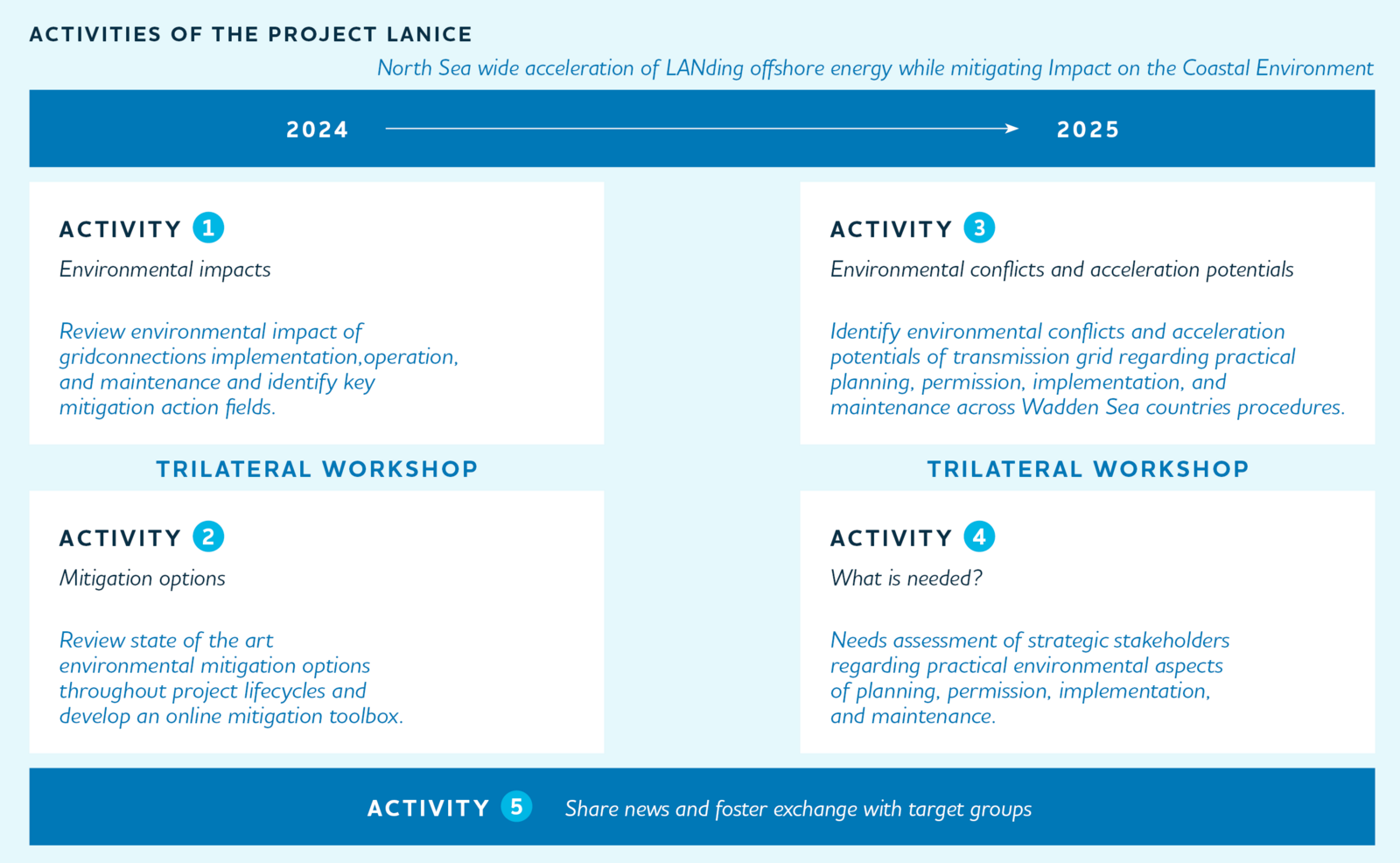
Five activities are the pillars of the LANICE project:
- Review potential environmental impact of grid connections laying, operation, maintenance and decommission on soft coast ecosystems and identify key mitigation action fields.
- a) Review state-of-the-art environmental mitigation options throughout project lifecycles and
b) develop a comprehensive online environmental mitigation toolbox. - Identify environmental conflicts and acceleration potentials for the transmission grid regarding practical planning, permission, implementation, and maintenance across diverse Wadden Sea country procedures and adjacent countries with comparable situation.
- Needs assessment of strategic stakeholders regarding environmental aspects of practical planning, permission, implementation, and maintenance on the ground.
- Share news and foster exchange with target groups on environmental impact, mitigation strategies, and acceleration potentials.
Status
The development of activities 1 and 2a) started in March 2024 and is expected to be completed in October 2024. They are being developed by a trilateral consortium of external experts led by the Dutch consultancy Witteveen+Bos and in close cooperation with the ad-hoc Working Group Renewable Energies (WG-RE). The consortium members are Deltares, DHI, Intertek and NIRAS from the Netherlands, UK, Germany, and Denmark respectively.
To date, the consortium has produced a first draft progress report which includes:
- An overview of the different environmental impact assessment methods in the Netherlands, Germany, and Denmark.
- A description of the techniques used for the construction, operation and decommission cables and pipelines. These techniques are linked to environmental and ecological impacts.
- An overview of the topics covered in the Environmental Impact Assessments (EIAs), Appropriate Assessment (AAs) according to the EU Habitats Directive and ecological quick scans, including differences and similarities between the three countries in their assessment approaches and how they address cumulative effects.
- Effect monitoring practices in the three countries.
- An overview of existing and planned grid connections and foreseeable future developments.
- A preliminary overview of best and feasible mitigation options for pre-construction, construction, operation, maintenance, and decommission.
- The most important knowledge gaps.
Next steps
The next steps planned until autumn 2024 are to organise a trilateral workshop to promote exchange, present preliminary results and refine information. The tasks will be worked on further by the consortium, supported by CWSS and the Working Group.
